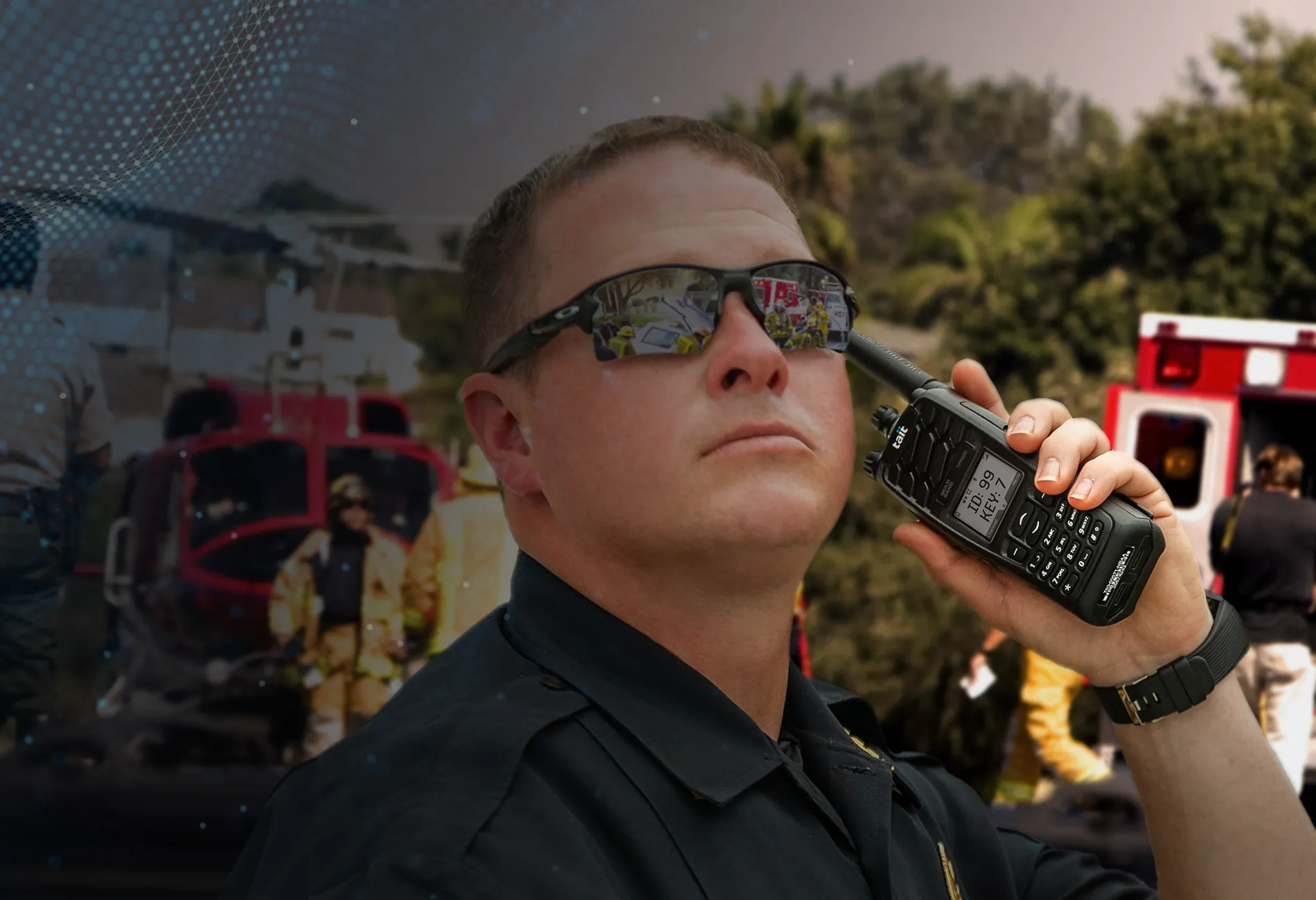
Clear, reliable communication is critical for public safety teams. Police officers, firefighters, emergency medical personnel, and other first responders depend on communication systems that work without interruption. That’s where the P25 standard comes in.
P25, also known as Project 25 or APCO 25, is a digital radio communication standard designed specifically for public safety organizations. P25 allows radios and systems from different manufacturers to communicate seamlessly with one another. This allows for more reliable communication, better audio quality, and enhanced security for mission-critical operations.
Understanding the Purpose of P25
Before P25, many emergency agencies relied on analog radio systems that often struggled with compatibility issues. Departments using different equipment made communication difficult during multi-agency responses.
P25 was created to solve that problem by establishing a standardized digital platform for two-way radio communication. As an open standard, multiple manufacturers can develop compatible radios, repeaters, and infrastructure equipment. This gives agencies greater flexibility when building or upgrading their communication systems.
Today, P25 systems are widely used by law enforcement, fire departments, EMS teams, utilities, transportation organizations, and federal agencies across North America.
How P25 Technology Works
Unlike traditional analog radios, P25 systems convert voice communications into digital signals before transmitting them. This digital approach helps improve audio clarity and reduces background noise, even in challenging environments.
P25 technology also improves spectrum efficiency. Agencies can maximize available radio frequencies while supporting large communication networks.
There are two primary versions of P25 systems:
Phase 1
P25 Phase 1 uses a technology called FDMA (Frequency Division Multiple Access). In this setup, each conversation occupies one channel at a time. Many agencies still rely on Phase 1 systems today because of their reliability and compatibility with older equipment.
Phase 2
P25 Phase 2 introduces TDMA (Time Division Multiple Access). This allows two conversations to share the same channel by dividing it into time slots. This effectively doubles channel capacity and helps agencies manage growing communication demands without requiring additional spectrum.
Many modern radios support both Phase 1 and Phase 2 operation, which helps organizations transition smoothly as systems evolve.
Conventional vs. Trunked P25 Systems
P25 networks can operate in two different configurations depending an organization’s needs.
Conventional Systems
Conventional systems assign each communication channel to a specific frequency. This setup is straightforward and works well for smaller departments or organizations with simpler communication requirements.
Trunked Systems
Trunked systems are more advanced and designed for larger operations. Rather than assigning fixed frequencies to individual groups, trunked systems dynamically allocate channels as users communicate. This allows many teams to efficiently share available radio spectrum.
Trunked P25 systems are commonly used in large public safety networks and regional emergency communication systems because of their scalability and efficiency.
Security and Encryption Features
A major advantage of P25 technology is its support for secure communications. Many P25 systems include encryption capabilities that help protect sensitive information from unauthorized monitoring.
Encryption options can vary depending on the agency’s needs, but these features are especially important for law enforcement, government operations, and other organizations handling confidential communications.
P25 systems are designed with reliability and redundancy in mind, helping agencies maintain communication during critical situations.
Why P25 Matters
As communication technology continues to evolve, P25 remains one of the most trusted standards for mission-critical radio systems. One of its greatest strengths is interoperability. Because P25 is an open standard, local, state, and federal organizations can operate on shared channels and communicate effectively in emergencies, even when using equipment from different manufacturers.
P25 solutions also support backward compatibility with legacy analog systems. This allows agencies to modernize their networks over time, without replacing all their existing equipment at once.
P25 delivers the reliability, security, and scalability that public safety organizations depend on every day. The standard is widely adopted and supported by multiple manufacturers, so agencies can expand or upgrade their systems over time without being locked into a single vendor.
GenComm understands how important reliable communication is for your operations. Our team can help you evaluate the right system for your environment and operational needs, whether you are upgrading an existing radio network or exploring digital communication solutions for the first time. Contact us to get started.